Some desires never arrive alone. They bring a shadow behind them.
In stories of the Bacá, wealth rarely appears innocent. Something changes hands: a promise, a body, an animal, a future life. In Ciguapa stories, the problem is not what can be bought but what cannot be captured. Her feet point backward and turn every footprint into a lie meant for the hunter.
Together they make an unsettling pair: the pact that binds and the being that escapes.
The Bacá: fortune that knows your name
Historian Lauren Derby studies baka or bacás as “hot” spirits associated with the sorcery side of vodou/vodú in the Haitian-Dominican borderlands. In the accounts she analyzes, they can assume animal forms and generate wealth for their owners. They are not merely nocturnal monsters. They are living archives of economy, coloniality, race, and power.
Derby identifies a disturbing detail: the animals assumed by bacás—dogs, pigs, cattle, and horses—belong to species introduced by colonizers. The supernatural creature therefore carries material history: Indigenous dispossession, slavery, property, suspicion of another person’s wealth, and the fear that extraordinary prosperity conceals a debt.
Oral versions vary. The Bacá may protect an estate, multiply assets, punish intruders, or demand a terrible payment. There is no single contract because every community tells the story differently. What remains is the moral question: when success comes too quickly, who or what paid for it?
That mechanism explains the legend’s survival. The Bacá gives animal form to what society may not be able to verify but can still perceive: unexplained wealth, impunity, exploitation, and power that seems to obey a different set of rules.
The Ciguapa: the insurgent footprint
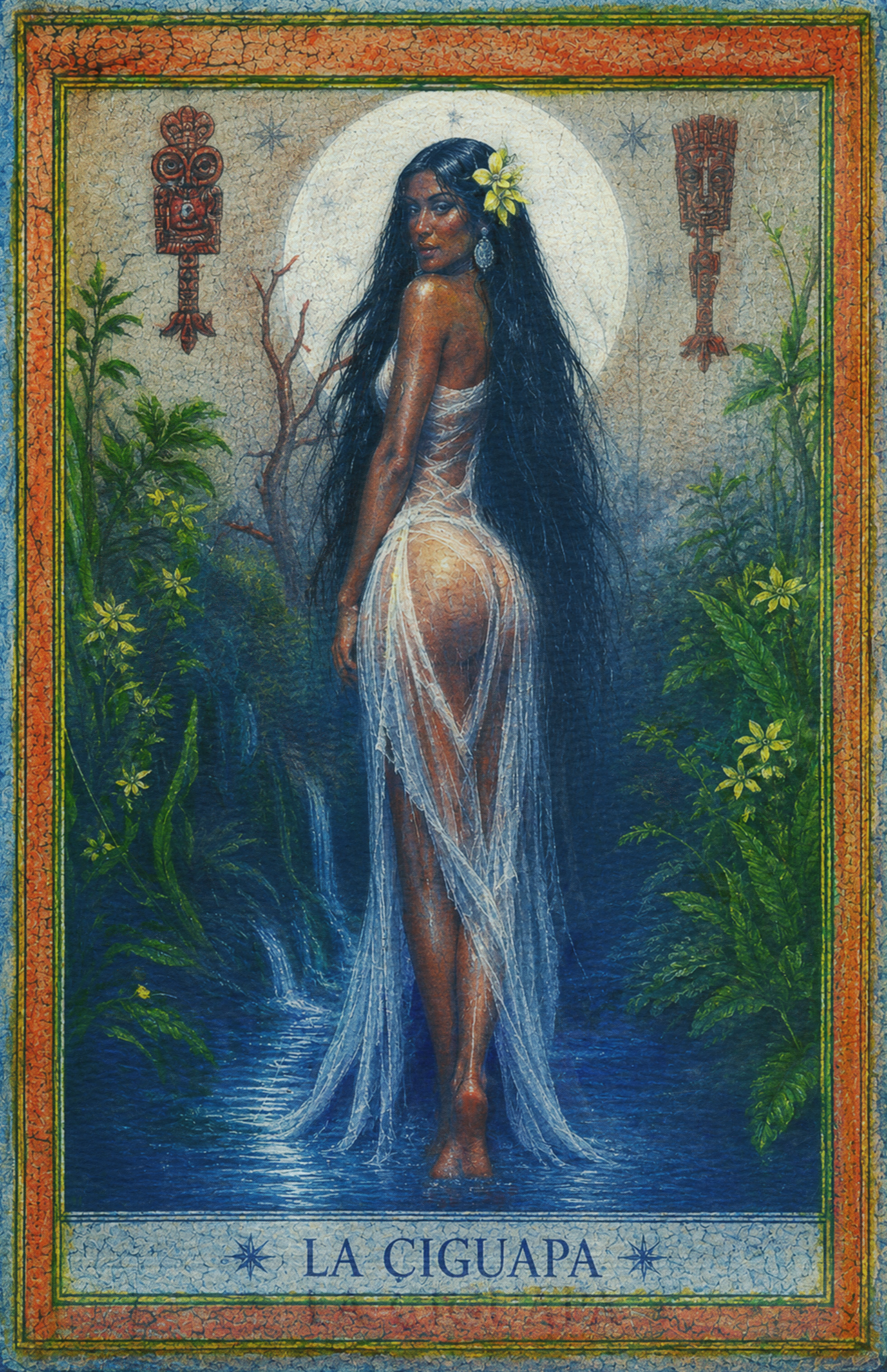
Depending on the version, the Ciguapa lives in the mountain forest, near streams, or at the edge of highland paths. She may appear young or old, alluring or threatening, human or nearly animal. Her most stable feature is her backward-facing feet. Her tracks indicate the opposite direction from the one she has taken.
The printed record offers at least one firm date. Francisco Javier Angulo Guridi published a 15-page booklet titled La Ciguapa in Santo Domingo in 1866. That does not prove he invented a tradition already moving through oral culture. It establishes 1866 as one of its earliest known bibliographic anchors.
For generations, many versions made the Ciguapa a warning: the woman of the wilderness who draws men away, the unruly body that must be captured, the danger of going out at night. Contemporary scholarship also reclaims her as a metaphor for Blackness, maroon freedom, ambiguity, and female autonomy. Ginetta Candelario proposes ciguapeo as myth, metaphor, and method—a Dominican way of disorienting the gaze that seeks to classify, possess, or domesticate.
The contradiction is the source of her power. The Ciguapa may preserve patriarchal and colonial fears while also offering a strategy of liberation. She does not walk “incorrectly.” She walks in a way that renders the hunter’s map useless.
Two arcana, two economies of power
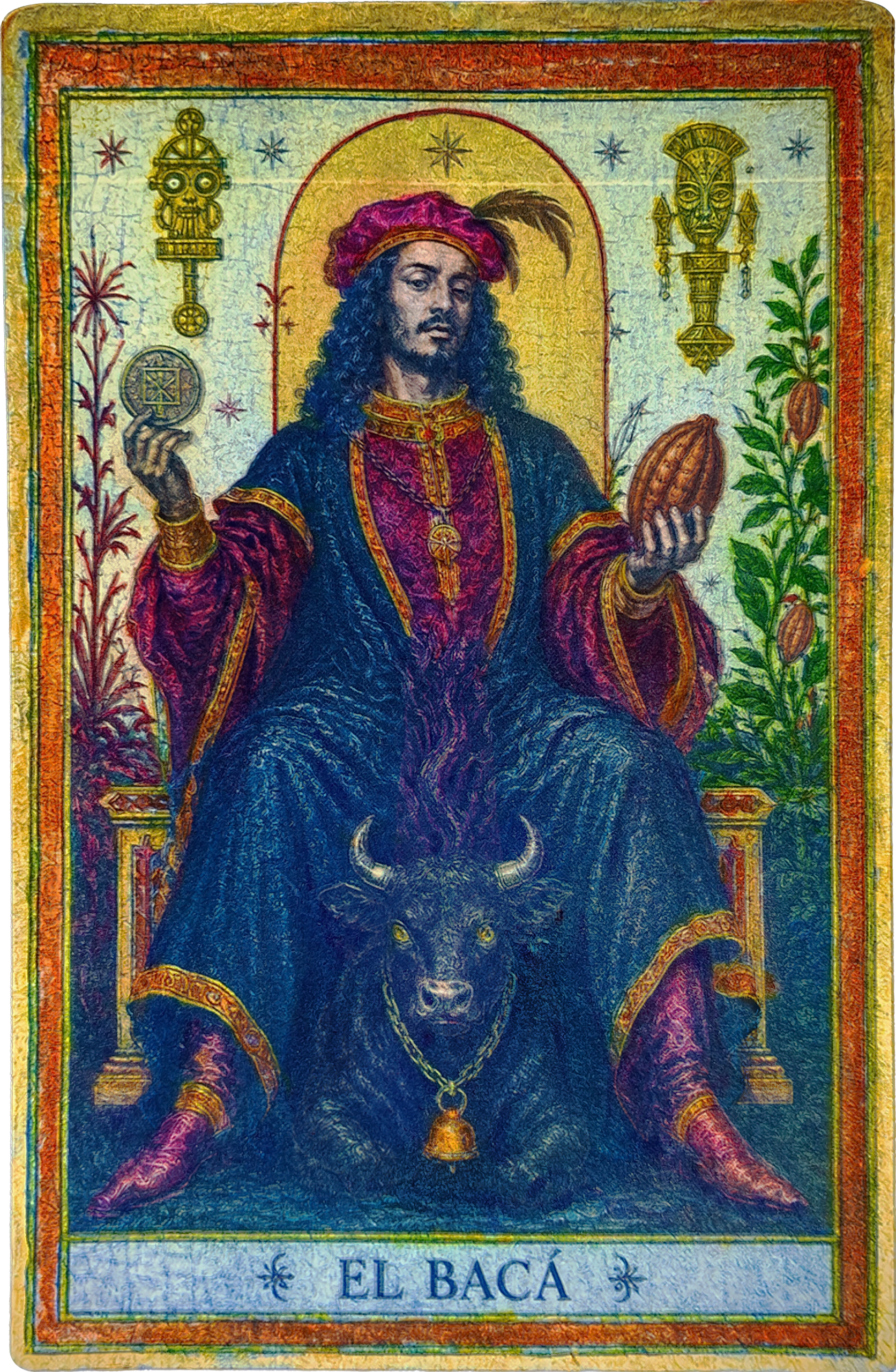
In The Arcanos of the House, the Bacá does not represent money itself. It represents the invisible pact behind a benefit. In light: resources, protection, cunning, and survival. In shadow: debt, greed, exploitation, and wealth that devours its owner.
The Bacá asks: What desire am I feeding, and what does it require as food?
The Ciguapa represents the sovereignty of remaining unfound. In light: autonomy, intuition, creative flight, and the right to secrecy. In shadow: isolation, manipulation, deliberate confusion, or the inability to return.
The Ciguapa asks: Am I lost, or am I leaving a trail only my pursuer needs to believe?
Their encounter creates a potent reading. The Bacá wants to assign a price to everything. The Ciguapa reminds us that some bodies, territories, and destinies are not for sale. He prospers through possession. She survives by making possession impossible.
Four figures before entering the forest
- 356 pages and 37 illustrations: the scale of Lauren Derby’s 2025 study Bêtes Noires, built from interviews and life histories in the Haitian-Dominican borderlands.
- 1866: the year Angulo Guridi published La Ciguapa.
- 15 pages: the recorded length of that early booklet.
- More than 150 years: the time the Ciguapa has moved between Dominican oral tradition and print.
Numbers do not contain these beings. They show how long both have unsettled the border between rumor, literature, experience, and symbol.
Painting without domesticating
The artistic decision is not to illustrate a legend literally. It is to preserve its mechanism.
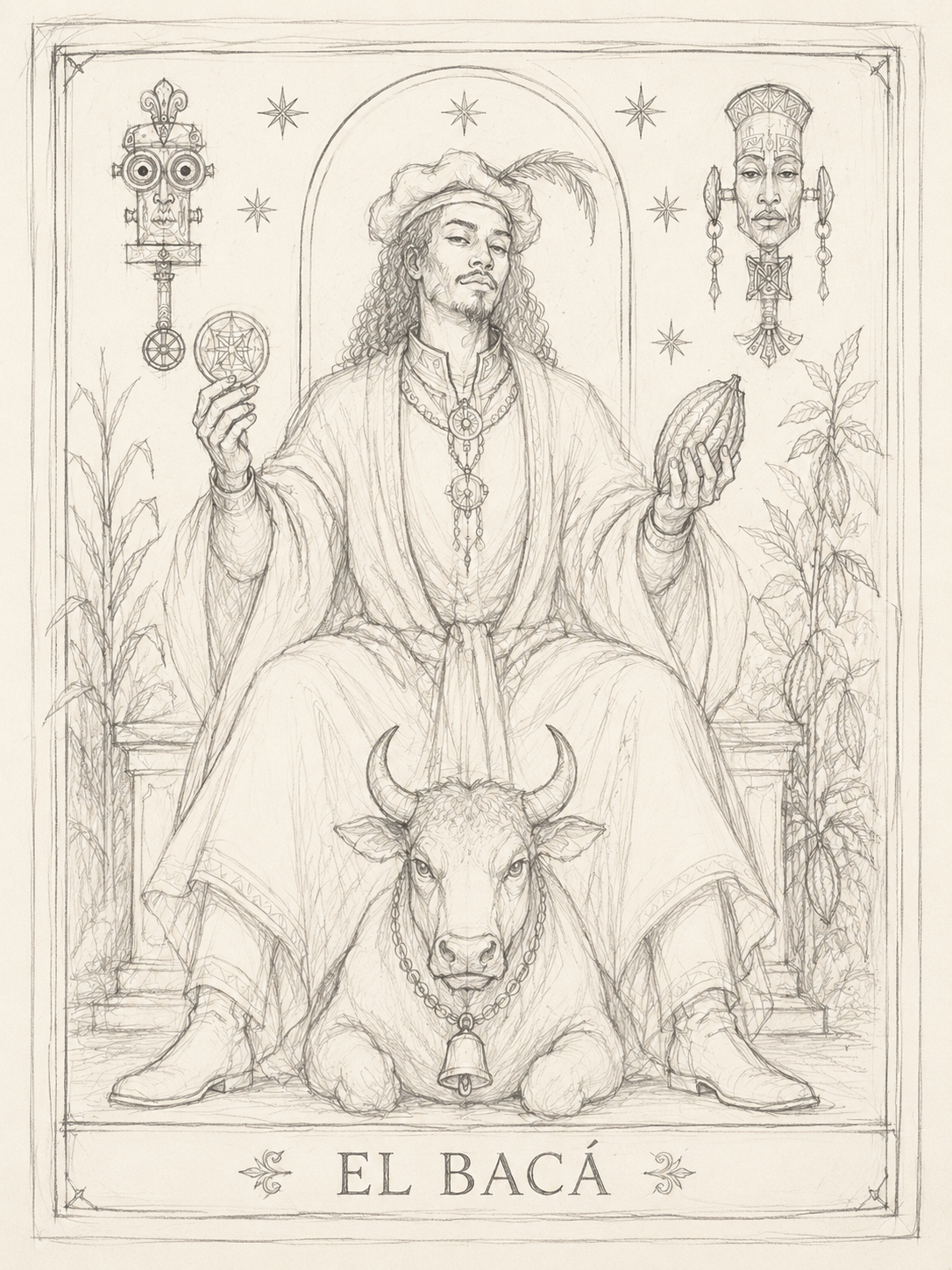
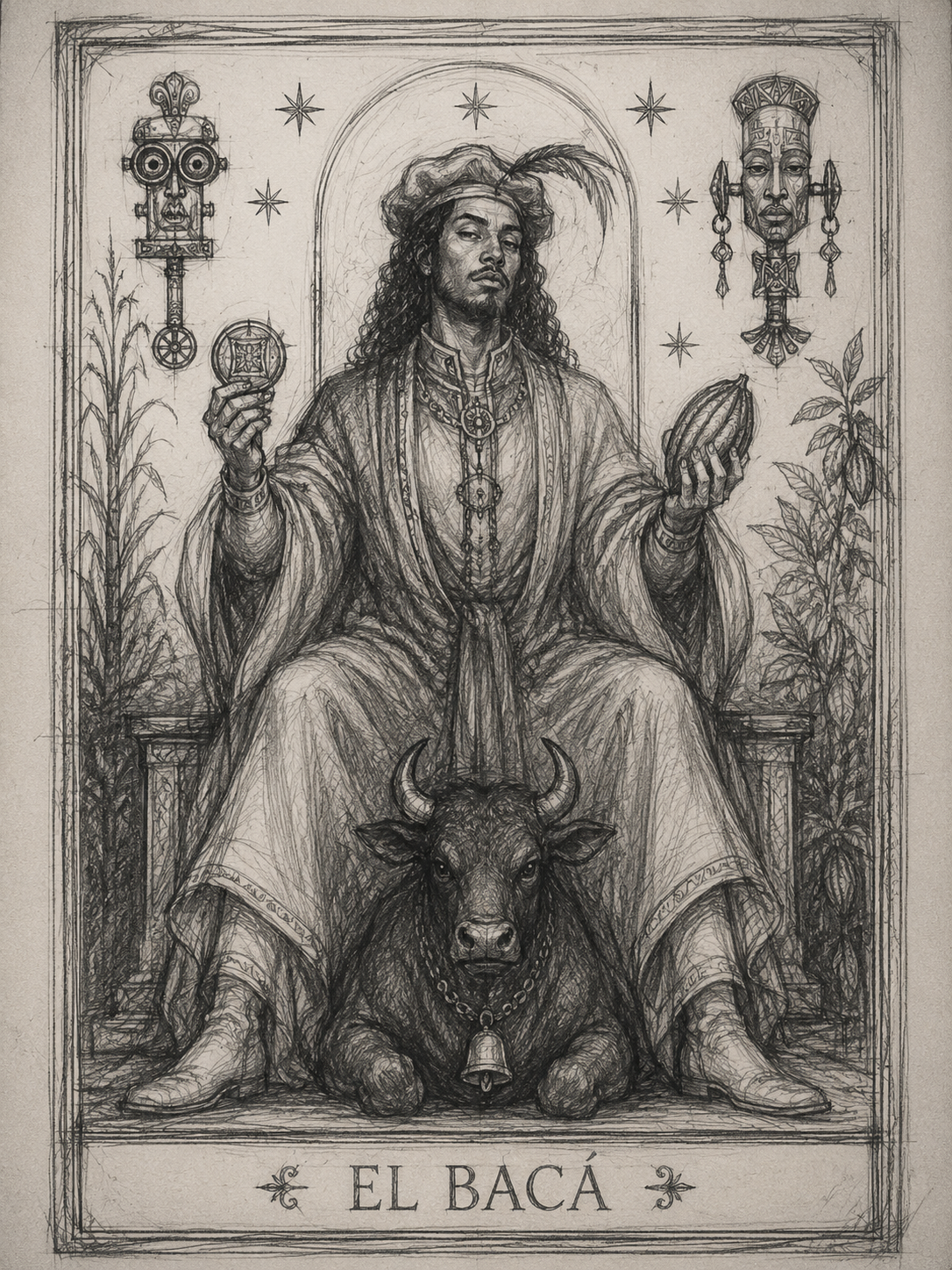
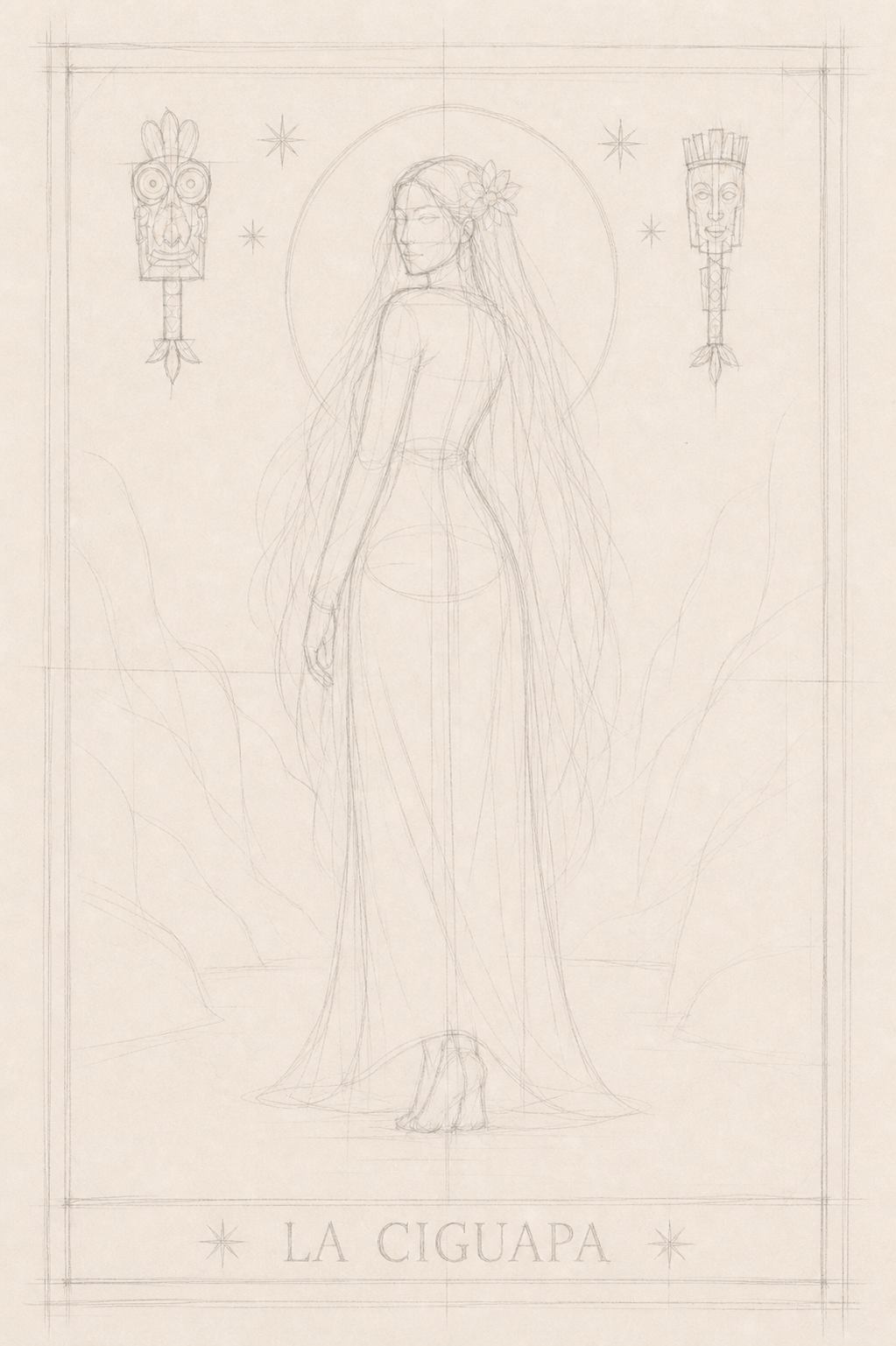
The Bacá needs an image that makes a promise feel heavy: an animal too alert, gold that resembles a wound, an architecture of abundance about to close like a trap. The Ciguapa needs the opposite: depth, forest, hair that confuses the limit of the body, tracks that reject the viewer’s perspective.
In both cases, beauty is a threshold. First it attracts. Then it accuses.
These cards do not certify that the beings exist as physical facts. They certify something harder to deny: societies invent beings capable of expressing truths that cannot be stated directly. The Bacá speaks of the suspicion following power. The Ciguapa speaks of the price a woman or a community pays for refusing to be traced.
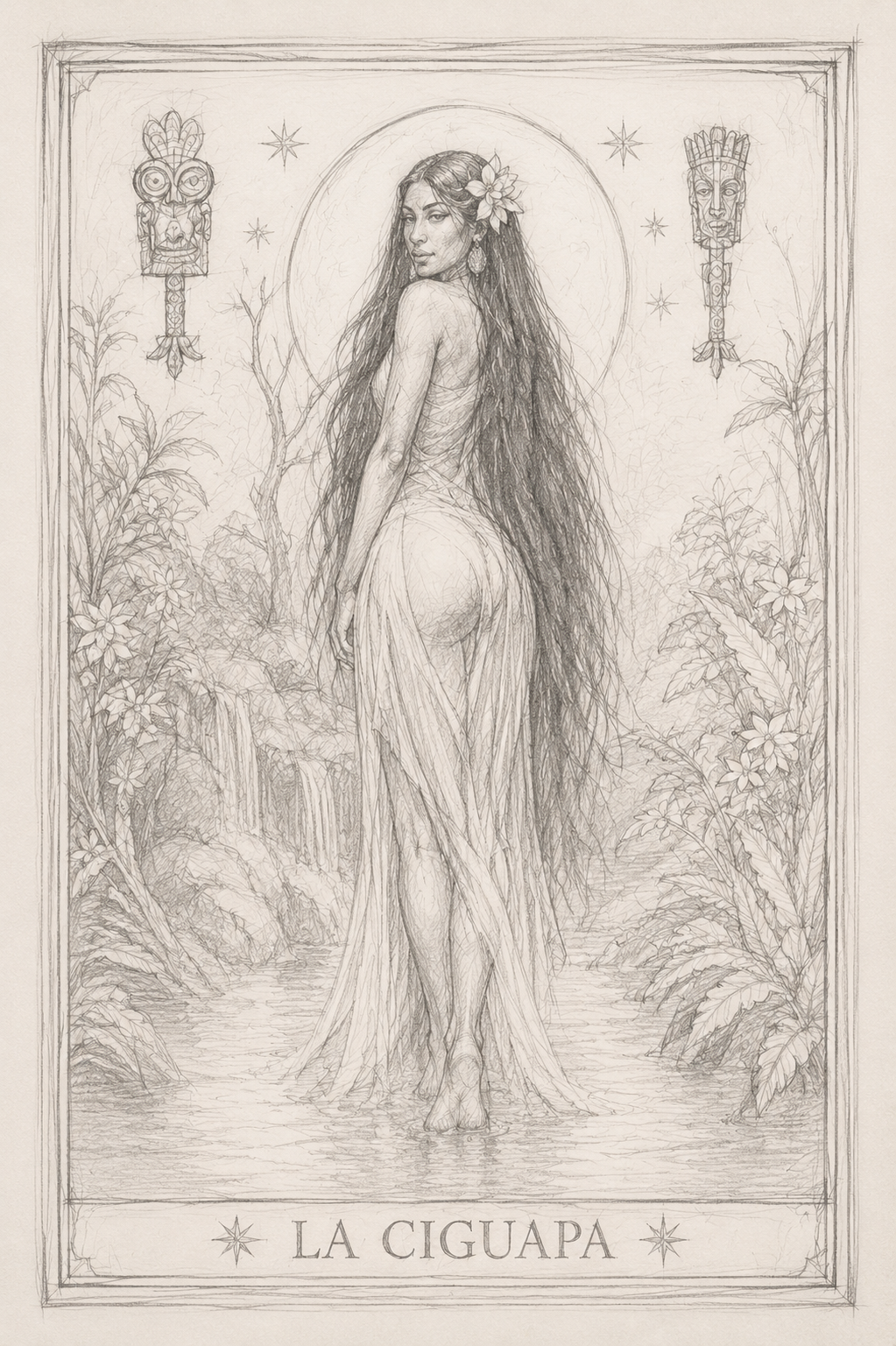
From sketch to arcana
Showing the process changes the reading. The earliest lines still contain the questions: where the weight falls, which symbols remain, how much the face should reveal, and how much the forest should conceal. The developed sketch turns that search into structure. The final work adds matter, color, and time while preserving the uncertainty of the first line.
In the Bacá, the drawing moves from an almost ceremonial architecture into a surface charged with red, blue, and gold. In the Ciguapa, the basic lines first establish the turn of the body, the mass of the hair, and the contradiction of the feet; the forest and nocturnal blue later transform that impossible anatomy into territory.
The sketches are not merely preliminary material. They are evidence that the arcana was researched, questioned, and constructed before becoming an image.
In Turin, they will face one another. One will ask what your desire costs. The other will have changed direction before you can answer.
From sketch to arcana